June longreads: The patchwork rainbow of Pride in Southeast Asia
Reads from politics, culture and Myanmar

Hello friends!
I had a hell of a June, which means I didn’t get out half as many newsletters as I wanted. But I did read a lot of great stuff on the bus. Here’s what I loved from last month.
See you next week,
Erin Cook
🌈 Happy Pride!
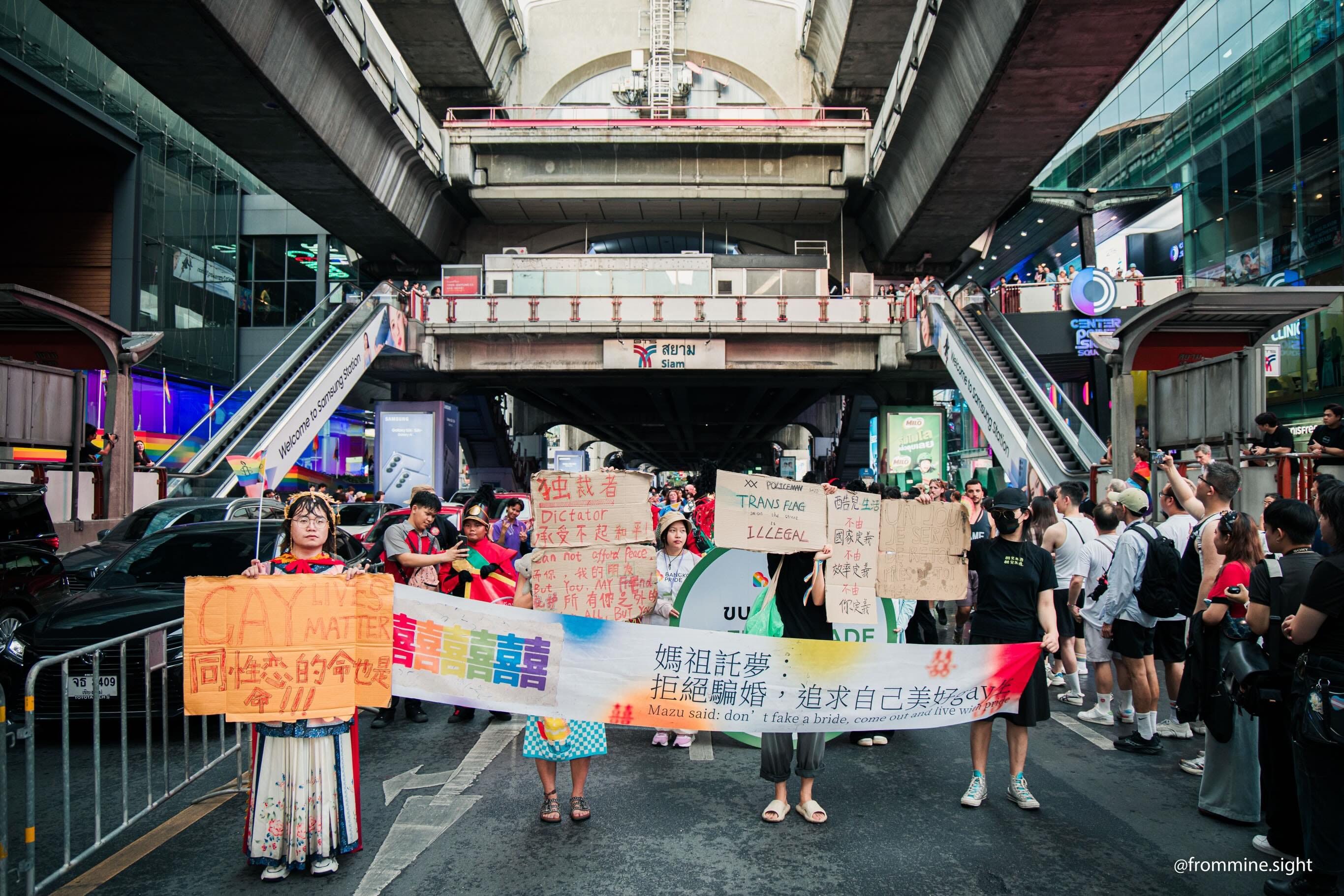
June was Pride Month across the world and it’s a fascinating moment to take stock of where the region is at. LGBT rights and freedoms are not anywhere close to equal across Southeast Asia — from some parts we don’t even get a little story about a small community somewhere doing something interesting. Just radio silence, which is often for the best for the peace and safety of many.
Reformasi with Dédé Oetomo
Dédé Oetomo is nothing short of a legend in Indonesian and Southeast Asian LGBT circles. He’s been a loud advocate for his community since the 1980s and has watched the attacks on LGBT Indonesians ebb and flow. I was especially thrilled to speak to him this year with an enormous discourse surrounding President Prabowo Subianto and his Cabinet Secretary Teddy Indra Wijaya.
The Pride movement and the illusion of irreversible progress — Henry Koh, Nikkei Asia
Henry Koh, the executive director at International Lesbian, Gay, Bisexual, Trans and Intersex Association, uses this op-ed thoughtfully, reflecting on the changing world and what that means for LGBT rights. Once, progress was synonymous with increased freedoms and safety for LGBT people. So what happens when progress stalls?
A few days ago, I revisited photographs from a Bangkok Pride shoot taken three years before. What struck me was not nostalgia, but distance — the distance between the world in which those images were made and the world in which we are now being asked to understand them.
Across Asia, Pride Month is unfolding under conditions that challenge one of the central assumptions that shaped the past two decades: that rights, once secured, would endure, and that visibility would continue — however unevenly — to translate into protection, recognition and dignity.
Pride in Indonesia is longer than a coming-out story — Reza Mardian, the Jakarta Post
Reza spoke with three queer Indonesians this month to take stock of the many varied stories of coming out. For some, being out means to everyone but your closest family and to others, it may mean fearlessness online and in their creative work.
Coming out, if it happens at all, rarely looks here the way it looks on screen. There is no music swell, no father who comes around, no single conversation that changes everything. For many queer people in Indonesia, it’s more like a lifetime of negotiation.
Perhaps that is why Pride here is rarely loud. It’s rather quiet, tactical and deeply internalized.
It is not about letting yourself out. It is about figuring out who you are willing to let in.
🗳️ Politics
Grateful ‘for a couple of hours of normal life’ — Outlook, BBC
This is a bit historical for our politics section but this era of Indonesia is endlessly fascinating to me, so! Tari Lang was 14-years-old in 1965, her Javanese father and British mother worked for Sukarno, and a chill descended over her entire life and country. She’s written a book about her life and her experiences and spoke on length with Outlook. Tari Lang is very charming and it’s a treat, despite the high stakes. Though be warned, there’s a whole section in which two British accents say ‘yoghurt’ repeatedly.
From ceramah to chatbots: Malaysian political parties turn to AI tools to analyse, engage voters — The Star (via ST, I can’t find the original!)
Malaysia has two hot state elections on the calendar in the coming weeks and it’s remarkable how much campaigning has changed in just a few short years. The traditional colour hasn’t disappeared, but parties vying for control are taking a punt on AI tools. What gets me here isn’t that these innovations are being used by political parties — duh — but how soulless it’s turning what was once a really vibrant democratic endeavour. Using AI to create memes and jingles for voters sick to death of politicos and their dramas? Inspirational.
Umno Youth secretary Hafiz Ariffin said AI will help parties produce content more efficiently, from generating images and posters to helping supporters verify claims made by political rivals.
New formats such as songs, memes, animation and issue-based explainers could also widen voter engagement, particularly among younger constituents.
However, he stressed that digital tools cannot replace traditional campaigning.
The Iran War Turned Asia’s Fragile Energy Dependence Into an Emergency — Joshua Kurlantzick, CFR
Is the US/Israel-Iran war over? No idea! Every morning I wake up to a push notification telling me it’s over, and every night I go to bed with one telling me it’s back on. What is unequivocally certain, though, is that the impact on the region’s energy security was immediate and deep. As Kurlantzick writes here, some of those scarier measures introduced by governments across Southeast Asia are being wound back and now it’s more about ‘what those shattered assumptions are going to mean going forward.’
Nuclear power is getting a serious second look across the region. Five members of the Association of Southeast Asian Nations (ASEAN) — Indonesia, Malaysia, the Philippines, Thailand, and Vietnam — are now actively pursuing atomic energy. Malaysia has set a 2031 target for its first reactor. Vietnam advanced a nuclear cooperation deal with Russia this week, and Bangladesh is racing to bring its Russia-backed plant online. If current plans hold, nearly half the region could have nuclear capacity by the 2030s.
I Shall Not Live in Fear - Netiwit Chotiphatphaisal and Tyrell Haberkorn, Dissent Magazine
Netiwit Chotiphatphaisal is challenging last month’s Constitutional Court ruling in Thailand that found mandatory conscription into the army does not conflict with the 2017 constitution’s protections of religious freedoms and personal liberty. How can it not, asks Netiwit. He went along when called up for his conscription day in 2024 but instead read a statement: “All Thai citizens should have the equal freedom to choose whether or not to participate in military conscription. No one should be coerced or forced, as it is not beneficial to individuals or the nation.” Here, he expands his case.
We need to understand the reality of Thai society. The Thai elite has long used nationalism to preserve its power. Even political parties that once promised to transform mandatory conscription into a voluntary system have treated this demand as a tool for votes rather than a moral commitment. The call to end conscription is popular, especially among young people. But when the moment comes, it is easier for politicians to retreat into nationalist rhetoric, invoke threats from outside enemies, and avoid conflict with the military and the deep state.
📖 Culture
How K-pop, loneliness gave rise to Bangkok’s outdoor aerobics classes — Kenya Akama, Nikkei Asia
If there’s a story in the region, there’s a k-pop angle. Which is exactly what Akama found in Bangkok, where the mass outdoor aerobics that dot the city centres have taken a younger, more Hallyu flavour recently. It may be a perfect melding of the Bangkok old and new solution to the emerging loneliness crisis: “I’m not good at physical activities, but I made a lot of friends my age, so my goal is to come once a week from now on,” one 26-year-old participant said.
Public aerobics classes have become popular because “in modern Thai society, many people feel lonely or experience social media and digital fatigue, and the idea of social interaction through sports such as aerobics is seen as appealing,” said Ryusuke Aoki at the Hakuhodo Institute of Life and Living ASEAN.
Eighty-three percent of people in Thailand feel lonely, according to a 2025 survey published in part by the Thai Health Promotion Foundation and Chulalongkorn University. People in single-person households in urban areas and individuals with health problems are found to feel the loneliest.
Boomers can’t stop using AI to create fake images of Singapore history — Kai at Singapore Samizdat (subscribe!)
Fine, I admit it! I got sucked in by these ‘country x over the decades’ posts like Kai includes in this fantastic piece interrogating AI-ified history online. It’s so easy, isn’t it? He points to some fascinating recent data about attitudes towards AI by generation and has a very plausible argument for why older Singaporeans are resharing en masse. It’s a thoughtful piece, one of many at Singapore Samizdat that’s quickly made it one of my must-reads.
Some of it seems innocuous at first glance: users stating that they used Google’s Gemini to colourise old black and white photos they found in the National Archives.
Others are total and extremely obvious fabrications. AI-generated images that are often accompanied with captions that beckon the reader to share memories of a rosier past. Concerningly, most users either don’t realise or don’t care.
From bilingualism to multilingual confidence: What the Dear You debate is telling us — Lily Kong, Straits Times
I said it last month and I’ll say it this month and I bet I say it next month when someone else runs something brilliant: I love Singapore language policy stories! Dear You (which is playing at the Dendy in Canberra and I’ll be seeing on Saturday off the back of this story) is a film about a Chinese family in Thailand, filmed in Teochew. I’ll be seeing it in Teochew with English subtitles. In Singapore, it’s dubbed into Mandarin with the Teochew version available as a treat. The Teochew tickets got snapped up and punters were asking why they had to pop over to JB to watch it the way the filmmakers intended it. It’s all about that language policy.
What is at issue is not simply whether one film should be shown in Teochew or Mandarin. It is whether a language framework that served Singapore well in one era now needs recalibration for another.
This is not an argument against bilingualism.
Singapore’s bilingual policy has been one of the most consequential and successful pillars of our nation-building project. It gave us a common working language in English, enabling inter-ethnic communication and global connectedness. It also sought to anchor cultural continuity through the teaching of official mother tongues. In a young and vulnerable state, this was not merely educational policy. It was strategic statecraft.
Why Millions Are Falling for Thailand’s Same-Sex Romance Dramas — Randy Thanthong-Knight and Suttinee (Ying) Yuvejwattana, Bloomberg (gift link)
Heated Rivalry? Pfft, late to the party. Thailand’s homegrown boy’s love (BL) and girl’s love (GL) TV shows depict LGBT romances with a genre flare, think time-travel or period piece. It’s a huge business now with Thailand producing nearly 100 serieses a year and fandoms spanning the planet. It’s not prestige TV, says Chulalongkorn University performing arts lecturer and onetime producer Wittavat Sungsakijha. “These stories aren’t driven by complex plots,” but “it’s about emotional connection.”
Thailand’s dominance reflects a combination of factors few Asian countries have matched: the longstanding visibility of LGBTQ communities, government-backed soft-power ambitions through cultural exports and studios that have learned how to turn the genre into a scalable business. The result is an industry that treats same-sex romance as mainstream entertainment, generating tourism, merchandise sales and sold-out fan events at home and abroad.
🌴 Environment
Islands in the Storm: Climate Change and Conflict in the Philippines — Georgi Engelbrecht, Crisis Group
The Southern Philippines is at a hell of a nexus. It’s trying to detangle a complicated political and economic situation with the weight of climate change breathing down its neck. Extreme weather destroys much of the agriculture in the region, which affects the livelihood of many men who, anecdotally, are encouraged to join armed groups to make up their shortfall. There are many, many good reasons to address climate change and peace in Mindanao is an admirable one.
Conflict over land has been a constant in the Philippines. About one fifth of the working population earns a livelihood from agriculture, which contributes roughly 10 per cent of GDP. The numbers are higher in the Muslim-majority Bangsamoro region, where almost 60 per cent of the work force is employed in farming, forestry and fishing. Combined, these endeavours account for 30.4 per cent of the region’s economic activity. Spanish colonial campaigns dispossessed Muslim and Indigenous communities of their land, a trend that continued under U.S. colonial rule in the first half of the 20th century, when Christian settlersseized economic and political control in the Muslim-majority region. The resulting deep-rooted inequality helped spur the Moro Muslim insurgency that began in the 1960s. To this day, political dynasties not only hold vast tracts of arable land in the Bangsamoro but also dominate business networks and other parts of the economy. (High levels of inequality characterise many other rural areas of the country.)
From forest sanctuary to Cambodia’s scam zone — Meng Kroypunlok, Mekong Eye
Here’s an angle on the damned scam compounds I’d never considered. These enormous things sit on land in some of the most beautiful countries on Earth. Some of that land, Meng writes, was originally protected forest before becoming special economic zones. This piece digs into the data and also has a poke around who is being targeted by authorities and why.
But beneath the suspension of the scam economy lies a much older story. Before MDS Thmor Da SEZ was developed by MDS Group, a company linked to tycoon and timber businessman Try Pheap, a dense forest canopy from Phnom Samkos Wildlife Sanctuary covered the landscape.
Established in 1993, Phnom Samkos Wildlife Sanctuary is one of Cambodia’s largest protected areas, spanning the Cardamom Mountains in western Cambodia.
Its intact forests host nearly 600 wildlife species, according to Cambodia’s Ministry of Environment, with 14% listed as endangered, critically endangered, threatened or vulnerable species in the International Union for Conservation of Nature’s Red List.
The ‘Parasite of Parasites’ Has Been Discovered in the Tropical Forests of Borneo — Marta Musso, WIRED
Universiti Malaysia Sabah scientists found something amazing in the jungle of Sabah. “An organism capable of parasitising other parasites” targeting ants that already have this nasty zombie fungus. There are others around the world that do this but this find has a unique horn-shape. I picked this one to include because it’s cool but I also had a cracking gag to make about parasites, though it’s so good it would never get to go to Penang again.
Scientists from the Universiti Malaysia Sabah have discovered a newly identified “parasite of parasites” in the tropical forests of Borneo. More specifically, it is what the researchers describe as a hyperparasite—an organism capable of parasitizing other parasites. In this case, its targets are zombie fungi.
The new fungal species, named Pleurocordyceps cornusynnemata for its distinctive horn-shaped structure, has been described in the journal Phytotaxa.
🇲🇲 Myanmar
‘I felt like I was close to dying’: Few options for domestic abuse victims — Frontier Myanmar
One of the things that frightens me the most about Myanmar currently is that none of the ‘usual’ social issues that exist everywhere disappears under the junta; they’re magnified. I think it’s brilliant that Frontier Myanmar has put itself to work to continue highlighting those stories alongside its coverage of the conflict. Here, the outlet speaks with women who are desperate to leave family violence situations but are unable to do so due to poor support, the economic crisis and traditional ideas about gender.
While both spouses in Myanmar often contribute financially to the household, traditional gender expectations persist. Even when working outside the home, women face a “second shift” at home, as domestic duties like childcare and cleaning are still widely seen as their responsibility.
Men also face heavy pressure as designated “heads of the household.” Traditional norms discourage them from helping at home, anchoring their worth entirely to providing financially. If a man fails to provide, he faces social ridicule, often being insulted as “living under a htamein [woman’s sarong].”
Meanwhile, the financial situation for many people in Myanmar has worsened since the 2021 military coup, due in no small part to the regime’s gross mismanagement of the economy. Many factories have closed, while others, like the one where Than Than Sint and her husband worked, have laid off staff.
How paragliding soldiers carrying bombs rain destruction on Myanmar’s villages — Harriet Barber, the Guardian
Sometimes, in Sagaing region, which has been bombed to hell by the military regime for years, rescue teams will be digging locals out of rubble when they hear ‘the telltale chainsaw-like sound of engines.’ Paragliding soldiers and bloody big bombs are coming back for another round. “People try to run to the bomb shelters. But there is usually not enough time,” Lwan Thu, an activist from Sagaing, told the Guardian.
“The junta essentially buys and assembles commercial motorised paragliders. Then they send up soldiers to drop mortar shells,” says Shayna Bauchner, a Human Rights Watch researcher.
The geographic spread of the attacks appears to be increasing. Acled data shows paramotor attacks were recorded in 42 townships during 2025. In the first four months of 2026, they were used in an additional six townships.
For every two attacks there is at least one death recorded, says Acled, with some leading to dozens of fatalities. The group has recorded at least 321 deaths from paramotor and gyrocopter attacks since 2025.
Inside Myanmar, rebels are losing ground as military forces men into army — Quentin Sommerville, BBC
Forced conscription is something we’ve followed along with since the policy was first announced a few years ago. It churns my stomach to think about too much, but this piece from the BBC is a must-read. The grisly move is paying off for the junta, with the tide now seeming to turn against a few of the armed groups across the country. “The conscripts had to do everything. While the regular soldiers hardly had to work,” one conscriptee tells the BBC.
The military still only fully controls less than half the country, but it has been making gains - including key townships and retaking a critical road from Mandalay to Myitkyina in the north. Thousands of soldiers are advancing in an attempt to re-establish control of several border areas including Kachin, Chin and Karen states.
The BBC travelled to Myanmar without the permission of the authorities — the only way to report from rebel-held territory. During the 10 days we were there, we spent time with rebel fighters, and travelled to hospitals and front line positions in Bago and Karen states to report on how the war is unfolding.